


The Iranian Circus.

Apr 9
10 min read
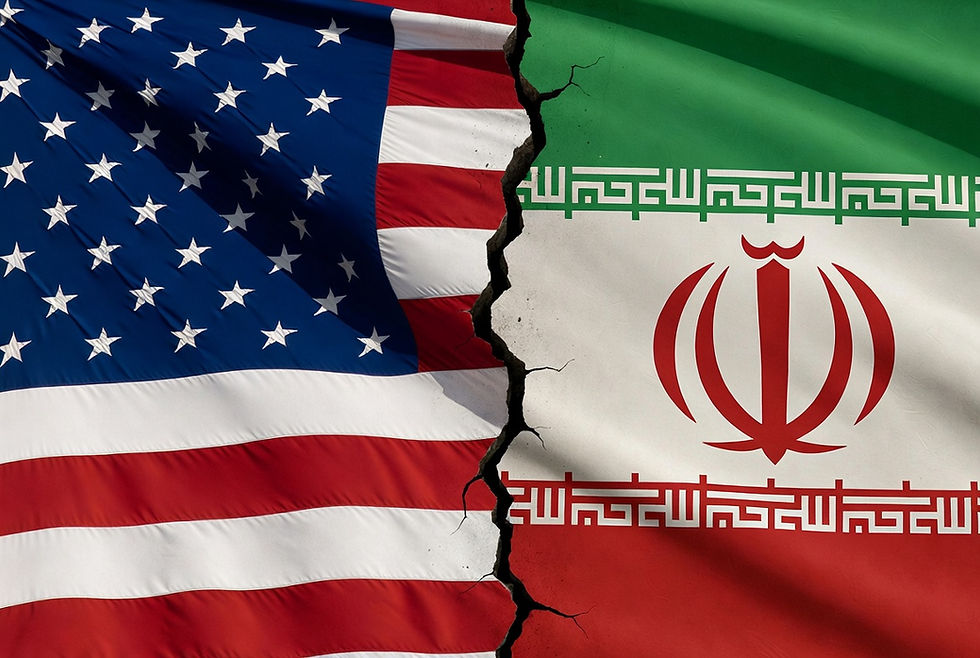
What is happening in Iran is not normal. Not because of the conflict itself—that is, in its own way, the most logical thing the Americans could do, knowing a nation that shoots its own children at school—but because of what happened before and what is happening now. We are facing the imperialist and monarchical follies of the White House, which has completely lost its sense of proportion, playing Risk with the entire world as if it were a game, almost a joke. All of this to prevent a state from having the atom bomb (and hegemony over oil). America screams that Iran is the "black wolf," behaving like a lost lamb, when the black wolf is actually the one passing themselves off as a lost and innocent lamb. But let’s take it one step at a time.
Iran and the Love for Uranium.
It is often thought that the "Iran/Atomic" issue is a recent one. I thought so too. I was convinced that Iran had only thought about the bomb for a few years and that it was a plan entirely conceived by the Islamic regime. I couldn't have been further from the truth. In reality, Iran has been flirting with uranium since the 1950s.
Want to know the funny part? Try to guess how Iran obtained the green light and support for atomic energy. Precisely from the United States. Life is funny sometimes, don't you think? Now, those same United States are bombing Tehran.
A Two-Way Collaboration... or Perhaps Not?
It all began in 1957, in the heat of the Cold War. Under the American "Atoms for Peace" program, the USA and Shah Mohammad Reza Pahlavi signed a nuclear cooperation agreement for civilian purposes—meaning the splitting of the atom to produce electricity and scientific research in the medical field. From then until the Islamic Revolution, the two countries collaborated closely in this sector. In those years, the Shah dreamed of a modernized Iran with over 20 nuclear power plants, actively supported by American, French, and German technologies.
The relationship was so close that in 1967, the United States even provided Iran with its first 5 MW research reactor. That reactor was destined for the University of Tehran for scientific research.
Three years later, the Americans asked themselves: "What if Iran had the bomb? Hmm, better not!" Thus, in 1970, Iran ratified the Non-Proliferation Treaty (NPT), committing itself not to acquire atomic weapons, thinking it was an equal partner with other nations of the world, thinking it was contributing to the world.
In truth, it wasn't exactly like that. A bit of historical context: it was a strange period where Iran was passively controlled by the United States, given that in the 1950s, the USA had overthrown the democratic and nationalist government of Mossadegh to restore the absolute power of the Shah. Not to mention it was the Cold War, and an ally in the Middle East against the communists like Iran (a major oil producer) was more than precious. This collaboration between Iran and the USA should be seen as the USA "using" Iran rather than a true partnership between two sovereign countries.
The Return of Islam.
With the Islamic Revolution of 1979, and thus with the return of Khomeini from exile, everything changed. Relations with the West were abruptly severed. The new Khomeini regime initially publicly suspended (this is important) the atomic program, defining it as "anti-Islamic," trying in every way to avoid the idea that an Islamic state could even think of collaborating with the "Stars and Stripes Devil."
The rebranding might have worked if not for the fact that, during that same period, Saddam said, "Oh, there’s a crisis in Iran? Excellent, let’s go take their oil!", trying to seize control of Iranian oil wells by taking advantage of the coup and Iran’s internal instability. This war, and its outcome, would later lead to the first Gulf War in the following decade.
For nearly ten years, from 1980 to 1988, Iran found itself involved in a costly and exhausting war. The war ended in a stalemate, with Iran and Iraq finishing in a draw. That conflict, however, drastically changed the perception of national security in Tehran. Khomeini must have thought, "Damn, if I’d had the bomb, we would have defeated and killed Saddam years ago!"
The idea was so brilliant that Iran launched research into uranium enrichment (for military use) in a completely clandestine manner, striking deals with Russia to complete the Bushehr plant and obtaining technologies—often through the Pakistani black market—for enrichment. Why clandestinely? Well, first, the 1970 agreements were still in force. Second, you can't publicly claim that nuclear power is "anti-Islamic" and then invest money in that very technology you repudiated. Finally, if the United States had known that Iran had begun enriching uranium to blow up the world, Washington wouldn't have taken it very well. And the last thing Khomeini wanted was to make the Americans angry. Think about it: it took Iran ten years to stop Iraq; against American military power, there was no hope. So, hide everything and keep quiet in Tehran.
For a few years, everything proceeded. Khomeini controlled the state, wiped out the opposition, and reigned over Iran as an Islamic dictator would in an Islamic state, perfectly hiding the military nuclear program. The truce, however, was short-lived. In this world, it is very difficult to keep something secret for long.
In 2002, an opposition group revealed the existence of secret nuclear sites in Natanz (enrichment) and Arak (heavy water). The news went around the world. In Washington and the world in general (always under American influence), this was not pleasing at all.
Iran justified itself by saying, "We’ve never even seen those two places!" One might have thought the news was false, but it wasn't. When the West confirmed the reports were true, Iran said, "Okay, fine! You caught us! But we are only enriching uranium to turn on our lightbulbs! Don't worry! We respect the treaties." Suspicions remained for a few years. After all, the sites were built in ultra-protected bunkers under mountains. A perplexed world asked: "If you are only creating energy, why protect your research in that way?"
However, there was no concrete proof of plutonium enrichment for arming atomic bombs.
As mentioned, nothing serious happened. Yet, the world could no longer ignore the Iranian issue. To ensure everything proceeded as well as possible, Iran, the United States, and several world powers signed the JCPOA (Joint Comprehensive Plan of Action) in 2015, a treaty that forced Iran to enrich uranium to a maximum of 3.67%. Essentially, Iran could only use uranium for electricity.
The story seemed to have found its happy ending, but no. The suspicion surrounding those underground laboratories was too strong.
In fact, those suspicions were well-founded. In 2018, the Mossad smuggled thousands of documents (the Atomic Archive) out of Tehran, proving the existence of the old "Amad Project," a structured plan to design, test, and integrate a nuclear warhead onto a ballistic missile. This means Tehran truly wanted the atomic bomb.
Tehran’s plan was very subtle. The idea was to create missiles without warheads and create everything needed for them without assembling them. In case of threats, Iran had created a production level such that it could easily assemble the warheads in days, mount them on the missiles, and fire them. In case of preventive inspections, no one would know about the missiles until their launch, since previously there were only missiles but no warheads. Too bad Israel ruined the plans.
At that point, Western intelligence and the International Atomic Energy Agency (IAEA) also mobilized, accumulating evidence suggesting goals very different from those Tehran continued to state publicly. In 2023, IAEA inspectors found traces of uranium particles enriched to 83.7% at the underground Fordow site. By mid-2025, reports indicated that Iran possessed enough 60% enriched uranium to produce several nuclear warheads if enriched further.
From 2018 onwards, the "game" transformed into a geopolitical chess match. Phases of harsh sanctions alternated with attempts at diplomacy. Between 2002 and 2026, Iran was hit with something like over 5,000 active restrictive designations among those imposed by the USA, the European Union, the UN, and other allied countries. We are talking about economic, energy, banking, commercial, flight-freedom, and diplomatic sanctions, and who knows what else, which effectively damaged the Iranian economy, sending it nearly into bankruptcy.
The War.
The Conflict.
In April 2025, Donald Trump had begun negotiating with Iran. Strange that he hadn't immediately launched missiles. Don’t worry, there’s still time for that. Everything was going well when Iran was caught red-handed, working on uranium enrichment even though it wasn't allowed due to the 2015 JCPOA. Needless to say, this JCPOA really sucked. So Israel (with USA support) launched an initial 12-day strike against the nuclear sites. This froze negotiations for months.
In January, despite the compromised trust, a new attempt at negotiation was made in the name of stability and peace. Progress was being made, but due to internal instability in Iran (civil protests ending in bloodshed), the Americans deemed Iran an unreliable partner and decided to attack massively. Along the lines of "why talk when we can bomb?"
Since February 28, 2026, the United States and Israel have launched a massive campaign of targeted airstrikes against Iran.
The first goal was to eliminate the leadership that was so "annoying the Americans." A single missile and Supreme Leader Ali Khamenei and other high officials were blown up. Actually, they exploded. I don't think they found anything left after the blast.
When asked for reasons by the Western world and beyond, the USA and Israel justify the military intervention with the need to "eliminate the Iranian threat"—a threat no one felt or perceived. According to Trump, Iran is accused of accelerating toward the nuclear threshold... a nuclear threshold that the Americans themselves showed them in the mid-20th century. Trump even declared he wanted to "dig up and remove" the enriched uranium buried in the hit sites. How he planned to do that was not explained.
This inevitably eliminated any space for traditional diplomacy. You don't talk to someone who blows your leader and part of your cabinet into a thousand pieces. Obviously, there were immediate retaliations. Iran began attacking American military bases in the Persian Gulf, creating panic in the Gulf countries and a sensation of total war in the Middle East throughout Europe. At that time, the fear that Iran could strike not only Israel but also European and American bases was a remote possibility, but in the general panic, it seemed all too realistic to Trump.
The joint American and Israeli forces, for a couple of months, hit over 13,000 targets, destroying much of the air defenses and weapon factories to neutralize the missile threat. But civilian targets were also hit.
The Black Gold Reprisal.
Given that Iran could no longer use missiles to hit anything and that there was no money left for a military war, Tehran got clever—damn clever. Tehran knew perfectly well it had control over the Strait of Hormuz. What is the Strait of Hormuz? It is a small strip of sea controlled by Iran. Why is it so important? Approximately 20% of the world's oil transits through that Strait, destined for Europe, Africa, Asia, and the United States.
Iran used its geographical position as an economic defense weapon: it partially closed the Strait to tanker traffic. Iran applied an economic chokehold against the entire world, USA included. Isn't it ironic? Trump in 2025 used the economic squeeze (tariffs) to control the world, and Iran used oil to control the United States. The mere partial closure of the Strait caused violent spikes in the price of crude oil, reaching nearly 100 dollars a barrel, with the consequence of gasoline prices skyrocketing.
Loneliness.
Since that February 2026, we have witnessed something incredible.
The Americans attacked alone (supported by Israel), trying in every way to drag NATO into this conflict. NATO, being a defensive coalition, replied: "Donald, actually no! It’s your war, handle it yourself!" A perfect example is Spain, which categorically said "no" to the Americans immediately, making Trump so angry he even screamed for economic sanctions against the land of Sangria. I even read about a trade embargo. Then all the other Western countries followed suit one after another, like mosaic tiles. Even Italy, a known supporter of Trump, had the courage to say, "Donald, hell no!"
Not only that—and this is pure cinema—while Trump was bombing and wallowing in his magnificence, Europe went en masse to Tehran, against Trump's "will," to negotiate a deal to reopen the Strait of Hormuz only for European ships. I can imagine the scene of the Europeans going to Tehran and pretending they had never seen Trump and had never heard the word "America" in their entire lives, while Trump himself screamed "treason." We are facing the pinnacle of consistency: first the West nearly ruins Iran with sanctions and isolates the state completely, then they make deals when oil transport stops working.
At that moment, Trump was alone with Israel, while the whole world condemned the United States and made deals with Tehran. Not knowing which way to turn, on April 8, 2026, Trump, together with the Iranian government, declared a 15-day ceasefire, during which diplomacy must activate to find a solution. There is a ten-point pact that will have to be worked on.
It is truly comical to think that, as long as Trump thought he had allies (puppets to use as he pleased), he did whatever he wanted, but as soon as he realized he was alone and spending billions for no logical reason, he decided to activate diplomacy.
Even stranger is seeing how the entire cabinet is silent. This radio silence is very weird. On social media, no one speaks of the conflict as if it didn't exist. And yet the Trump regime was always so vocal when it came to foreign policy. Truly strange.
Small Reflections.
Sure, the Americans destroyed military and nuclear bases in Iran, but at what price? Trump achieved nothing.
I even read that Trump attacked Iran to gain control of the oil trade to pay off the national debt. Even if that were true, the whole world didn't play his game, being tired of living in a constant state of alert and even accepting to make deals with Iran. The world prefers to talk with an Islamic dictatorship it doesn't like, rather than follow the "saviors of the world and protectors of peace."
Furthermore, if the Americans wanted to free the Iranians from an oppressive regime, they completely failed. The Iranians hated the Supreme Leader and would have even accepted a regime change, but not in these terms. Now the Iranians will hate the Americans even more, having interfered with violence in a context where the Americans had no business. Along the lines of "the enemy of my enemy is my friend."
Whatever happens, it is yet another demonstration that the greatest threat does not come from "those who want us dead," but from those who claim that someone wants us dead.
M.


Comments