


Taylor Swift: The Women of the Century

Apr 3
27 min read
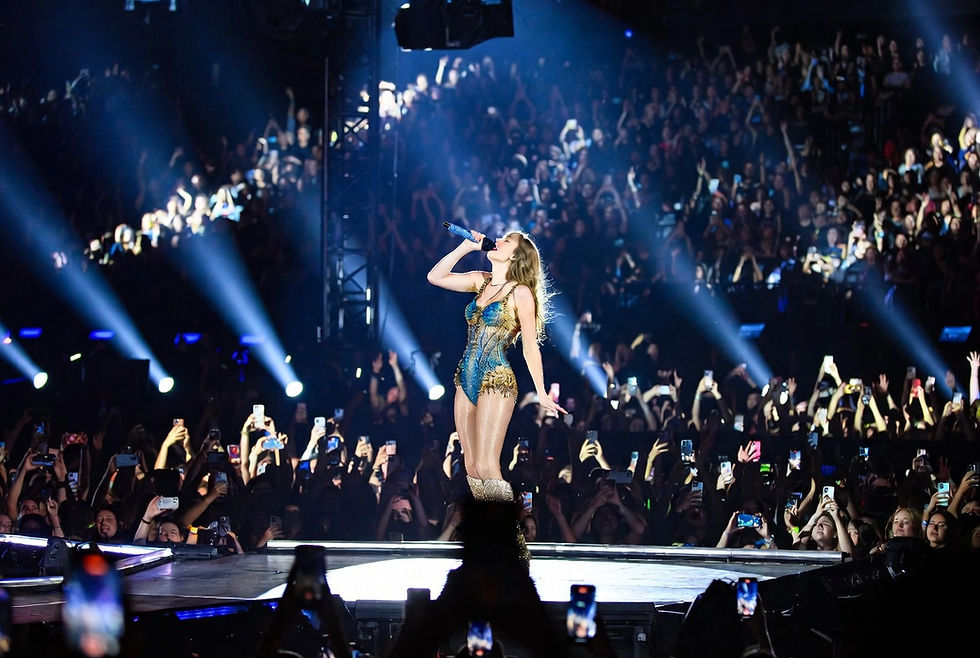
We are witnessing the greatest superstar of the century. On this, we all agree. The numbers representing her speak for themselves and are almost an understatement: Taylor Swift is not just a singer; she is a personality who transcends every label, comparable to Michael Jordan, Lewis Hamilton, or Cristiano Ronaldo. Those generational stars that happen once every hundred years—perhaps once and never again.
I am writing this post from the humility of someone who wants to understand. I know very little about her, only what the gossip columns have written. I want this space to be a medium for me, and for those reading, to delve into the story of a woman who is rewriting the rules of the game.
We won't just explore Taylor Swift as a piece of country and pop music history. We will try to understand how it was possible for a girl barely out of her teens to go from acoustic guitars in Nashville to becoming a record-crusher and a nearly mystical figure for millions of fans worldwide.
A Happy Child.
Her "career as a singer" didn't appear instantly like Jesus to the believers at Lourdes. She wasn't one of those prodigies who at two years old instinctively knew what they would become when they grew up, or what their great skill would be. Taylor, like all little girls, had a very normal childhood made of continuous discoveries and intense loves. The incredible thing is that everything she adored as a child shaped her future, without her even knowing it.
Her childhood began not in Nashville, but in Pennsylvania. Her parents, Scott and Andrea Swift, owned a farm (Pine Ridge Farm), where little Taylor helped her parents with the pine trees. Not being strong enough to move them, her task as a child was to pick praying mantis cocoons off the trees before they were sold, to prevent them from hatching in customers' homes. This idyllic and somewhat isolated childhood fueled her imagination. She has often stated that living there taught her about waiting and the magic of traditions—themes that constantly return in her lyrics.
Like all little girls, she had a very active personality with very intense passions.
Her first great love was horseback riding. She adored horses. This was a love she inherited from her mother. According to history (or legend), she got on her first horse at nine months old and never got off. By age three, she was already galloping. That love even led her to compete seriously in English horse riding competitions. It was a specialty that required extreme precision, poise, and control. But it wasn't just a love and a competition; it was the first piece of the mosaic.
Precision, poise, and control are three major elements we find in her manic precision during live performances and in the creation of her art. But back then, for that little girl, that galloping was just pure fun, as everything should be at that age.
Between one competition and another, Taylor discovered two other loves—perhaps even greater, if possible—fundamental to her immense career.
The first was theater. At age 9, her attention shifted to musical theater. She traveled regularly to New York to take acting and singing lessons, participating in local productions like Grease and Annie. All those appearances on a stage, in front of an audience, created that security and confidence in dominating the scene that she later showed in all her concerts (including the Eras Tour).
We have precision, poise, control, and stage presence. But a musical career cannot exist without music.
That was a chance encounter, like those in great romance movies. That love blossomed on a day like any other. It all started with a broken computer. At age 12, on an ordinary day in little Taylor's life, the computer broke. A repairman named Ronnie Cremer went to her house to fix the damage. That repairman could have fixed the computer and, once finished, gathered his tools and left. Destiny, fortunately, had other plans.
That man or boy (I don't know how old he was) saw a guitar in a corner. That angel did something that would forever change Taylor and modern music: he asked her if she wanted to try the instrument. Intrigued, she accepted, and he taught her three chords. Unfortunately, I don't know which ones.
The sound those tense strings produced over a wooden box was magic for Taylor, who fell madly in love with the instrument, but above all, with the sound. That instant was the spark that ignited the fire that would burn inside Taylor and inside millions of fans around the world.
With that guitar, Taylor wrote her first song, "Lucky You," of which only a few copies exist today, kept by those who love Taylor most of all.
Having discovered music, Taylor lived a moment of dualism. During that period, the girl realized that although she was good and achieved results in local competitions, her heart did not belong to the stable, but to the stage. It wasn't easy to find the courage to tell her mother that she would focus on music instead of riding. The fear of disappointing her parents was a huge burden, but the heart wants what it wants. Fortunately, her mother understood; otherwise, I wouldn't be here telling the story of her explosion.
She decided to abandon competitions to devote herself totally to music and theater, but the love for horses never died, simply finding a new dimension of existence in Taylor's heart.
Life in Nashville.
Nashville was certainly the most important stage of her career. But it wasn't all immediate, as any respectable epic goes. Like all great stories, the stars align when they want to, but always perfectly on time.
The first contact with Nashville happened at about 10 years old, watching a documentary on Faith Hill and Shania Twain on television. She noticed a fundamental detail: both had had to move to Nashville to make it. In little Taylor's mind, it meant only one thing: "Nashville is the place for success!" From that moment on, she began "relentlessly nagging" her parents to take her there.
At age 11, during a spring break, she convinced her mother to take her to Nashville. Most likely, her mother gave in just to stop hearing about it.
Once in Nashville, what was the plan? Taylor wanted to "break through," but what was the "Trojan Horse"? Well, remember that at 9 she participated in musicals? Good. For the two previous years, she had enjoyed singing over karaoke tracks and recording herself, making CDs of her home performances. That trip at age 11 had a purpose: it served Taylor to promote herself, handing out those CDs as if they were flyers.
The scene, if reproduced, would be like a Hollywood movie. Her mother, Andrea, waited in the car with her little brother Austin along Music Row. Taylor would get out of the car alone, walk into every single label, and hand over a demo CD with her country song covers. Her standard line was: "Hi, I'm Taylor. I'm 11 years old and I want a record deal. Could you give this CD to the right person?"
No one called her back. I would have been surprised otherwise. No one gives anything for nothing, even if you are 11 and show you have guts and conviction. In the beginning, failure is normal for a person trying to break through. Everyone fails at first. However, the more the spring is compressed, the more terrifying the momentum will be. Back home, she realized a crucial detail: singing other people's songs wasn't enough. She had to be different, original. It was then that she started writing her own songs and deepening that love for the guitar she had discovered by chance.
The turning point, however, was her parents, for two reasons.
The first reason was the work they did. Although they lived on a farm, her father, Scott Swift, was a financial broker for Merrill Lynch, while her mother, Andrea Swift, worked in mutual fund marketing. These were jobs that could be done "anywhere," not being tied to an office job, giving them a certain freedom of movement.
The second was the support. Instead of telling her "it's impossible," they decided to test her determination. Determination that was rewarded. At age 13, Taylor got an "artist development" deal with RCA Records. That was the signal the family was waiting for to convince themselves it was time to get serious.
They didn't move directly into the center of Nashville to avoid putting too much pressure on her. They chose Hendersonville, about 20 km away, so Taylor could live a normal teenage life going to school, while still being close to "Music City." A normal teenage life was exactly the reason for her success a few years later. The even better part? The family didn't "quit everything" in the dark. That flexibility came in very handy: Scott Swift, working for Merrill Lynch, requested and obtained a transfer to the Nashville office. This is a key point: they moved their operational base to support the most important investment of their lives—Taylor's talent—but they didn't risk everything. Economic stability in a teenager's life is a fundamental factor.
Shortly after the move, Taylor did something historic: she signed with Sony/ATV at age 14, becoming the youngest songwriter ever signed in the history of the Nashville publishing house. You don't sign with a record house if you don't have a shred of talent. From that moment on, every Tuesday after school, she went to write songs with professional songwriters (like Liz Rose). Here, the discipline learned during riding competitions was fundamental to being good at both school and music.
The "Big No".
Everything seemed to be going great: a teenage life in Music City, a record deal in her pocket, and that feeling that opportunity is just around the corner and that corner is approaching inexorably.
But there was a problem: Sony/ATV didn't understand who they had in their hands. However, it must also be said that it was hard to think that this girl of only 14 would have a meteoric impact on music.
The record label treated Taylor like an "ordinary little girl," forcing her to wait until she turned 18 to record her first album, and then intending to have her sing not her own songs, but those written by adults. A shitty choice, excuse the term. While waiting for age 18 (four years), she would have continued to write songs for others. I bet Sony/ATV is kicking themselves now, as their hands and arms are surely gone.
Taylor’s response to that request was: "I don't have time to waste; I'm writing these songs now and they talk about what I'm living now. Singing them as an adult wouldn't make any sense." How could you blame her? They were songs by a teenager for teenagers. When was she supposed to sing them? At 30?
Taylor made the crazy move typical of a 14-year-old girl: she left, walking away from everything. Before you're 18, it's always like that: all or nothing. Leaving a major label at that age, without another contract, was considered professional suicide. That move could have been the bulldozer of her career, crushing all dreams of glory. But not for someone destined for Olympus. The heavens had just begun the plan to make Taylor the supernova she is now, and that bulldozer was destroying all obstacles in her path.
As an independent artist, she continued to perform in Nashville clubs, both for pleasure and, above all, in the hope of being noticed by someone. For many nights, nothing happened. She would enter the club, get on stage, sing, be applauded, and go home.
One night like any other, during a performance like any other, at the famous Bluebird Cafe, Scott Borchetta was in the audience—a former DreamWorks executive who was dreaming of starting his own independent label.
Borchetta was struck by what he saw and heard. He immediately thought she was the thoroughbred that would introduce him to the music business. Borchetta approached her and said: "Look, I don't have a label yet, I don't have offices, I don't even have a name. But if you wait for me to start my company, I will make you a star."
Any normal person would have said no, and maybe even called the club's security. It was a crazy request from a crazy man. That promise was as if a random passerby told us to wait 2 hours on the street and that, if we did, we would get a million dollars. No one would accept. But Taylor had destiny as an ally. For reasons that transcend understanding, Taylor chose him over the major labels... a man who had nothing in his hand to offer. She accepted the completely empty promises of a practically unknown person.
That label became Big Machine Records, with which she had extremely high moments, but a truly tragic ending. She was their first-ever artist. When destiny knocks on the door and pitches a tent, whatever you do will be the right thing.
Pizzas, MySpace, and the First Million.
No, I'm not crazy, and the title makes sense. Once Big Machine Records was founded, Borchetta kept his word and brought Taylor to his label. At that point, the girl began working on her first album.
She didn't leave Sony/ATV empty-handed. Sure, she didn't have a contract, but she had a secret diary full of lyrics that no forty-year-old could ever sing with credibility. When she signed for the newborn Big Machine Records, she brought with her that treasure of songs written between 14 and 15.
On October 24, 2006 (at age 16), her debut album was released, "Taylor Swift"—not an original name, but it was just the first album, let's give her time.
The first single, released in June of that year, was "Tim McGraw." It was an artistic revolution and the Swift trademark. She used the name of a country legend (Tim McGraw) to get noticed by fans of the genre, but told a story of a summer love (her summer love) that ended before going to college. Instead of singing "Look how good I am," she sang: "When you think Tim McGraw, I hope you think my favorite song."
Taylor did something revolutionary: she named names. Was the boy she liked named Drew? She wrote "Drew looks at me." No one did that. Pop stars sang about "him" or "her" in a generic way. Taylor turned pop into a musical reality show. It was pure meta-narrative. Fans started scouring the lyrics to figure out who she was talking about. Thus was born the game of secret messages (Easter Eggs) that still drives the world crazy today... and fuels the controversy that she uses her exes as a source for success.
If she hadn't lived far from Nashville and hadn't had a normal adolescence, this song would never have come out.
The album, although it debuted at number 19, stayed on the charts for 277 weeks (more than five years!) and was certified 7 times Platinum.
Taylor spent 2007 living on a bus with her mother, visiting every single radio station in the United States to bring pizza and play live. That same year she was nominated for a Grammy for Best New Artist.
In 2008, at age 18, she was already a veteran. She had opened for giants like George Strait and Brad Paisley, stealing the show every single night.
But this is a debut album—how did a teenager talking about adolescence have all this success? What Taylor did with the record label was incredible. In that period, to break through, you looked for the radio. While other stars waited for radio airplay, Taylor used a then-new tool: MySpace. (And I am old enough to know what that is and to say I used it). It was basically social media, almost a precursor to Facebook. She spent hours personally responding to fan comments, creating a direct, unfiltered bond, making every fan feel like her "best friend." With that bond, the fans were almost "obliged" to buy the album, as if they wanted to support their best friend. Taylor transformed an artist/fan relationship into something incredibly strong, intimate, but at the same time detached.
Fearless, the VMAs, and Speak Now.
If the first album was a success (because you don't stay on the charts for 277 weeks if you are a flop), it was necessary to exploit the moment and strike while the iron was hot. That raw success was about to take on a whole new dimension.
If Taylor's debut had been a timid knock on Nashville's door, Fearless was the moment that door was kicked down, but wearing a sequined dress and cowboy boots.
Fearless is the anthem of adolescence. The album talks about loves gone wrong, first dates, school disappointments, and the relationship with her mother ("The Best Day"). For the first time, a pop star spoke about the problems of sixteen-year-olds with the dignity of a poet, without belittling them or treating them as teenage trifles.
"Fearless," as the singer herself said, did not mean not having fear, but having a lot of it and taking the leap anyway, like everything that happens in life.
Fearless consecrated her among the greats of music, not just country. "Love Story," the story of Romeo and Juliet with a happy ending, was the first country song in history to reach the top of the Pop charts worldwide. Thanks to this little gem, she became the youngest artist ever to win the Grammy for Album of the Year (a record she would hold for a decade).
With this album, the whole world got to know her, and she forcefully took her place among the big names in American music in general, shining with her own light.
We all know that as intense as the light is, the shadows are just as dark. Even if Taylor seemed to live in a world where the rules of humanity didn't apply to her, she too realized there was a price to pay.
Taylor lived those years with military discipline. There was no room for vacations. Her "living" was being on a tour bus. She said that at that time her only concern was: "How can I write a song that makes the listener feel less alone?"
She was aware that the iron was hot and had to be struck every single second. While her friends were going to university or parties, Taylor lived through the sentimental dramas typical of that age (first true love, first betrayal, first heavy breakup) in front of the cameras.
Her mother, Andrea, was her shadow. Taylor lived that period almost exclusively with her. It was "the two of them against the world." This allowed her not to lose her head despite the sudden fame, but it also kept her in a sort of protective bubble that made her, in some ways, much more mature than her peers but also much more isolated.
In those years, Taylor lived with an obsession with being perfect. She didn't want to disappoint anyone: her parents, the label, the fans. She felt obliged to be an impeccable role model. This brought a lot of psychological pressure; she felt she couldn't make mistakes, because a single false step would destroy the castle she was building. And that false step was much closer than anyone could have thought.
During the 2009 VMAs, Taylor was awarded for Video of the Year. Everyone seemed happy, except one: Kanye West. The rapper, known for his entirely un-moderate ego, took to the stage, forcibly took the microphone, and stated in front of everyone (on a worldwide live broadcast) that Beyoncé deserved the award. Beyoncé's embarrassed face was the best thing about those delirious minutes. That was a watershed moment: Taylor did not react with anger, which would have exposed her to criticism. Perhaps she was too shocked to say or do anything. Taylor, at that moment, thought the audience's boos were for her. That "staying still" saved her image and perhaps even her career, making her react with an apparent tranquility that transformed her in the eyes of the world into the "ultimate victim" and a silent fighter.
Excellent, a crisis overcome—it certainly wouldn't be the last. The curveball to avoid in the near future was not thrown by a singer, who understood that night at the VMAs "not to fuck with Taylor," but by the critics who often understand little or nothing about music.
After the success of Fearless, critics started saying: "Anyone is good if their collaborators write the songs for them." I bet Taylor, when she read those accusations, acted like Michael Jordan and took it personally.
Taylor's response was magnificent. No venomous interviews, no controversial social media posts. She did what she did best: write music. She wrote the entire Speak Now album completely by herself. No co-authors. Zero. It was the perfect response! How can you claim "someone is acting in the shadows" when the artist releases an album written all by herself? It was her declaration of intellectual independence. She proved to the world that the pen was hers and no one else's. From that moment on, critics stopped saying anything and evaluated only her music.
Red and 1989.
Although Taylor had global success and her first public controversies with her first two albums, she realized Nashville was becoming too small for her. It is a city she adored and that gave her so much, perhaps everything. But her star needed to expand and shine even brighter.
The third album, Red, is a melodic chaos that marked this dualism between the old and the new. Red is that classic hybrid work that is neither fish nor fowl. It was a success, because the numbers speak clearly, but it was too far from country music while not being close enough to pop music. It was as if she wanted to leave country, but wasn't sure that Pop was the right path. It was an experimental album, starting collaborations with Max Martin (the king of Swedish pop). However, in that nearly hour of music, you go from pure Country with banjo to a massive use of synthesizers.
That darting from one genre to another like a spinning top didn't do well. The album didn't win the Grammy for Album of the Year, and critics didn't particularly exalt it. Taylor took it personally again, recounting that she went home that night, ate a burger, and decided: "The next record must be an impeccable pop success. No more banjos." The die was cast and the road paved for the future.
Between 2013 and 2014, the plan began. The clean cut was visible. she changed her look, cutting her hair into a bob, moved to New York, and abandoned the country that had made her great. It wasn't spitting in the plate she had eaten from, but it was time to evolve. When she announced her new album, she openly told everyone: "This is my first officially Pop album," keeping the promise made to herself that night with that burger in her hand.
Scott Borchetta, terrified of the change, asked her to put at least three country songs on the record so as not to lose the historic fans. Taylor responded with a dry: "No." Basically saying, "no one bother me! Now I'm doing it my way."
Taylor was different. That girl who was always perfect, too often at the mercy of events and always looking for approval from others, was dead. What presented itself to the world was a woman who decided to leave insecurity behind and take on the entire world.
In 2014, 1989 was released. It was a musical atomic bomb. That album was sensational. Taylor Swift was everywhere. Global hits like "Shake It Off," "Blank Space," and "Bad Blood" were released. Taylor occupied the radio, TV, and newspapers. She became a deity on earth. Media attention was at levels never seen before.
With 1989, Taylor won her second Grammy for Album of the Year after Fearless. She became the first woman in history to win music's most prestigious award twice as a lead artist. She was no longer just a singer: she was an institution.
She felt like such an institution and so great that she even decided to challenge Apple on her own, bolstered by her media stature. This was the year she wrote the famous letter to Apple Music, forcing the tech giant to pay artists even during the free trial period, proving that her name held more power than entire multinationals.
In these years, Taylor invented a new way of communicating. She was no longer the girl alone on a bus with her mother; now she was the established pop diva, surrounded by the world's most famous models and actresses (her "Squad"). I remember the squad like it was yesterday. It basically seemed as if the Avengers had materialized in real life. She organized the famous July 4th parties at her Rhode Island villa. She used social media to show a glamorous but apparently "shared" life with fans.
She later revealed that during that period she suffered from eating disorders: she would look at her photos and, if she saw a hint of a belly, she would stop eating. She wanted to be "the model among models."
She lived in a bubble of such extreme success that she began to lose touch with how people perceived her. She thought showing her perfect life was a way to inspire, but the public began to find her "fake" or too calculating. Bad move for an artist who made honesty and transparency her workhorse.
Death and Rebirth.
2014 was the peak of her career until then. Perhaps it will be the maximum peak of her career in general in terms of media coverage. It seemed that everything she touched turned to gold. But this overexposure was starting to be annoying. People began to find her "too perfect," almost artificial. She had climbed so high that the fall would be disastrous. And so it was.
The beginning of the end was triggered by the one who ridiculed her in 2009: Kanye West. In February 2016, Kanye West released the single "Famous," where he stated that he was the one who made Taylor famous ("I made that bitch famous"), complete with a video showing her in a huge bed, naked, along with other famous people. He said Taylor knew about the song and agreed; she publicly denied it during her Grammy acceptance speech, throwing an epic shade at him about not letting others take credit for your success.
It could have ended there, but Kim Kardashian, Kanye West's wife, wouldn't have it and posted alleged fragments of phone calls between Kanye and Taylor on social media in which she said she agreed. A firestorm broke out on the internet. Taylor was media-slaughtered, labeled as two-faced and manipulative, described as a snake. The internet that had always held her in high regard decided to turn against her, trying to erase every trace of Taylor from the internet. The hashtag #TaylorSwiftIsASnake went viral for weeks.
Taylor did nothing publicly. The pain, anger, and disappointment of all that hatred would certainly not have made Taylor do anything intelligent. Since when everyone is against you, whatever you do or say is wrong, Taylor did the only sensible thing to do: disappear. She vanished from the radar for an entire year. She wasn't seen; she didn't post anything. It was as if she had been kidnapped by aliens. This gave the public time to process the hatred, calm down, and forget. She hoistered herself up in her London home and disappeared for a year, struggling with depression and doubts of every kind. That period was also fundamental because the squad dissolved like snow in the sun. The models and superstars Taylor was used to spending her days with vanished. That media face-plant made her realize who was really with her or who was with her fame.
She deleted every single photo from her social media; her website became a black screen. Her motto became: "There will be no explanation, there will just be reputation." She wanted the music to speak, not the apologies.
Then, in 2017, she returned. The album was titled Reputation. It couldn't be anything else. That album was the reckoning with that period. She used the image of the snake (which they had thrown at her as an insult) and transformed it into the symbol of her tour. In the "Look What You Made Me Do" video, she literally destroyed all her previous versions. There is an iconic line in the track: "I'm sorry, the old Taylor can't come to the phone right now. Why? Oh... 'cause she's dead!". Furthermore, she attacked all her enemies and told of that red flower (her love for Joe Alwyn) that grows in ground made sterile by the fire of media hatred. It wasn't a Grammy album, but just an album to close a dark chapter of life and open another.
The album was a success beyond reason, but it didn't win the Grammy for Album of the Year. In her documentary, you see the moment Taylor receives the news on the phone. She didn't despair. She looked at the camera and simply said: "I just need to make a better album." Despite critics saying Taylor was finished, the Reputation Stadium Tour became at the time the highest-grossing tour in US history. Taylor appeared on stage with 20-meter-high giant cobras, dominating oceanic crowds. It was physical proof that the internet cannot cancel real talent.
Taylor accepted everything, swallowed it all, and instead of apologizing, she bit back. She proved she was bigger than everyone, even the internet itself.
Lover and the Masters.
In 2019, there were two great moments in Taylor's history: the rebirth with Lover and "stolen" Masters. Let's start with the Masters.
Her old label (Big Machine Records) was sold to Scooter Braun. Bad move. Not only because Borchetta sold all the rights to Taylor's first six albums (from Taylor Swift to Reputation), but because Scooter Braun was also Kanye West's manager, held responsible by Taylor herself for the 2016 hate campaign. Taylor tried to regain control of those masters. Braun wouldn't hear of it. Taylor even offered to pay to get her music back. But nothing.
It seemed all was lost, but Taylor doesn't give up easily. At age 11, she went into record labels to hand over her albums and dealt with Kanye West at her debut. Something like this was a joke in comparison.
Instead of giving up, she read the contracts and discovered that she could re-record all the albums. At that point, she seized the opportunity and announced: "You don't want to give me the old albums? Fine, I'll record them all from scratch."
When she announced the plan, everyone called her crazy. No one gave her a cent, thinking no one would ever buy covers of already existing albums. Too bad they forgot a small detail: the Swifties. Those girls spread around the world were an army of millions of buyers and listeners. Taylor succeeded in the titanic feat of recording all six albums. This is where the "Taylor’s Versions" were born. It was an unprecedented commercial move.
Why are they crucial? Because from that moment on, anyone only listened to the new versions of the old albums, and companies—fearing retaliation from the Swifties—bought only the rights to the new albums. Scooter Braun found himself with nothing in his hand, since no one would pay anymore for an "old" product. That move, considered reckless by everyone, brought the investment funds that had bought her music to their knees.
This is a move that changed the rules of global recording contracts. She took back control of her legacy, proving that no one can own her talent if she doesn't want them to.
When she signed with Republic Records (Universal), what she obtained was a blank sheet where she wrote her own conditions: absolute and personal ownership of the masters of all her albums. She also demanded that if Universal ever sold its shares in Spotify, the proceeds should go directly to the artists. She used her power to protect all her colleagues.
Then, in 2019, she released the album Lover, the first album she actually owned. It is the album of rebirth after 2016. The snake exploded; black and white gave way to pastel colors, and dark Gothic fonts to something much more pop and happy.
This album was the representation of the new Taylor: a woman who is happy, in love, and at peace with herself. Her public image had become irrelevant, leaving room only for creativity and her physical and mental well-being.
Lover was also a political manifesto. She openly stood with the LGBTQ+ community against homophobia and gender inequality. The perfect example is the song "The Man": a powerful track where she asks: "If I were a man, would people criticize my every move as they do now?" It is her feminist manifesto, where she analyzes the music industry's double standards.
Despite the electronic pop, the title track, "Lover," is a timeless ballad that feels like it was written in the '70s. It is proof that, stripped of synthesizers and grand shows, Taylor remains a girl with a guitar who knows how to write universal love poems. She stated she wrote it alone, in the middle of the night, at the piano.
Lover is also the turning point of her life. From that album onward, Taylor stopped grand world tours for years and drastically reduced her workload. Not out of laziness, but for personal reasons. Her mother fell ill with cancer again, after the 2015 remission. In that moment, her life’s priorities changed: no longer the music, but her mother—the one who accompanied her for years on those buses and through the streets of Nashville. Every move she made in her career would be tied to the time she would spend away from her family; she had to be close enough to be with them as soon as possible in case things worsened.
Small spoiler: her mother is doing well.
The Records.
From 2020 to today, Taylor Swift has stopped being "just" a superstar to become an unprecedented economic and cultural entity. If her 20s were the ascent, her 30s have been the consolidation of absolute dominance.
The Pandemic and the "Stroke of Genius" (Folklore and Evermore).
While the world stopped for COVID-19, Taylor did not. Yes, she stayed home too, but she did what she does best: write and compose. While every other artist was home twiddling their thumbs out of boredom, she wrote a staggering amount of content. On July 23, 2020, without any warning, Taylor wrote on social media: "Most of the things I had planned for this summer didn't end up happening, but there is something I hadn't planned on that DID happen. Tonight at midnight, my 8th studio album, folklore, will be out."
It was a brilliant move: everyone was cooped up at home with plenty of free time. This gave the album an enormous listening potential, given the world didn't have much else to do.
It was a radical style change. She abandoned pop synthesizers to collaborate (remotely) with Aaron Dessner of The National. The result? An indie-folk, acoustic sound, full of pianos and strings. Within folklore, she wove together three songs ("cardigan," "august," and "betty") that tell the same story of betrayal and teenage love from three different points of view.
She proved to the critics that her pen didn't depend on her boyfriends, but on her ability to create entire worlds. She went from being a "diarist" to being a novelist in music.
The result? She won her third Grammy for Album of the Year with folklore. It proves she doesn't need big productions or dancing: her strength is the word. In that moment, even the snobbiest critics had to bow down. This woman would win even if she produced an album featuring the creaking of a door on a loop for an hour.
In December, she also released her ninth album, evermore. Two albums in a single year are the result of Taylor's compulsive writing. In quarantine, with nothing to do, she started writing and letting her mind run free. She explained at the time: "I just couldn't stop writing songs. It felt like we were standing on the edge of the folklorian woods and had a choice: to turn and go back or to travel further into the hospitality of this music."
If folklore is a summer afternoon in the woods, evermore is a winter night in front of the fireplace. It is a darker, more mature album that talks about failed marriages, imaginary murders ("no body, no crime"), and heartbreaking goodbyes.
The song "cardigan" became the symbol of this period. Taylor even put real wool cardigans up for sale in her store. She understood that in a moment of global fear, people didn't need club anthems, but comfort. She transformed her music into a warm blanket for millions of people alone at home.
Midnights and Total Dominance.
If you thought Taylor Swift still didn't have room for improvement, well, get comfortable.
The pandemic was over, the world could return to living in the cities, and so did Taylor Swift. Her tenth album was that very return to the city with Midnights. It is a conceptual, nocturnal, and deeply introspective album that marked the moment Taylor shattered every previously established record in music history. The title represents a musical journey through all those sleepless nights scattered throughout her life. It is not a linear album, but a journey through time: one song might talk about a night ten years ago, the next about last night, touching on themes like self-sabotage, revenge, falling in love, regret, and identity crisis.
With the album Midnights, Taylor achieved the impossible: she occupied the entire Top 10 of the Billboard Hot 100. The top ten most-listened-to songs in America were all hers. No artist in history, not even The Beatles or Michael Jackson, had ever managed that. Reading these lines, I think of the poor soul who was at 11th place. They could have been number one, if only it had been another year... or another era.
With Midnights, Taylor set the ultimate record: she won her fourth Grammy for Album of the Year. No one in the world has ever won so many in the premier category.
The Eras Tour.
And then we have the Eras Tour. The Eras Tour isn't a concert; it's an almost historical event. Even I, who am not a fan, knew Taylor Swift was in concert. The madness of that concert is represented by the numbers.
Whether it was because the pandemic gave people an uncontrollable urge to make up for two years of lockdown, or because it was her first World Tour after years of worry and apprehension regarding her mother's health, the fact remains that this tour crumbled every possible and imaginable record.
The tour wasn't just a promotional tour for her latest album, but a celebration of her career. The show is divided into "acts," one for each of her musical "Eras" (from Fearless to Midnights to The Tortured Poets Department). The concert lasts about 3 hours and 15 minutes; she sings more than 44 songs, changes dozens of costumes, and never stops. It is a feat of athletic endurance that left the entire industry speechless. It’s hard to describe the concert. I suggest watching the documentary about it, because it describes it perfectly. The workload behind those three hours is an almost non-human effort.
It became the first tour to gross over a billion dollars. The demand for tickets was so insane (14 million people in queue for a single date) that it crashed servers and triggered a US Senate investigation into ticket sales monopolies. In Seattle, fan enthusiasm caused seismic activity equivalent to a 2.3 magnitude earthquake.
Many cities (and even nations) saw their GDP grow thanks to her passing through. Full hotels, sold-out transport, restaurants under siege. Taylor Swift became a global economic engine. It is estimated that the tour generated an economic impact of over 5 billion dollars in the United States alone.
What else can be said? Nothing. If I were a Pop artist, I would be in big trouble. In my opinion, the others should just surrender due to "manifest superiority." Swift is practically the Rockstar Games of the music industry.
The tour created unique collective rituals. Based on a line from the song "You're on Your Own, Kid" ("make the friendship bracelets"), millions of fans worldwide began exchanging handmade beaded bracelets during concerts. It became a symbol of community and kindness, transforming stadiums into places of safe and joyful gathering.
The Tortured Poets Department (2024–2026).
Taylor announced the album on the 2024 Grammy stage, just as she was picking up her 13th award (her lucky number). Instead of giving a normal acceptance speech, she dropped the bomb: "My new album comes out April 19th." The internet literally crashed in seconds.
The album officially contains sixteen songs in its standard version. This was the version released at midnight on April 19, 2024. Two hours later, just to top it off, she released another fifteen, creating a double-disc version and bringing the total number of songs to 31, calling that version "The Anthology".
The album mixes the synthetic sounds of Jack Antonoff with the scholarly, acoustic ballads of Aaron Dessner. The lyrics are full of literary references (citing Dylan Thomas and Patti Smith) and complex words. It is a "dense" album, made to be read like a book of poetry rather than to be danced to in a club.
As soon as it was released, The Tortured Poets Department became the first album in Spotify history to exceed 300 million streams in a single day. It occupied the entire Top 14 of the Billboard Hot 100, confirming that, even after a twenty-year career, the public's hunger for her stories is insatiable.
In her private life, Taylor seems like a happy woman. She is happily engaged to Travis Kelce and leads a private life, away from cameras and paparazzi. The days of the "squad," luxury, and ostentation are long gone, having given way to a normal life, surrounded by trusted, loved, and loyal people... all while her bank account explodes. This is a dream life.
Final Thoughts.
As I said, I didn't know much about Taylor Swift. Damn, she is good. You don't win this much and you don't reach these heights of success if you don't have a shred of talent.
The thing that makes my brain explode is that it all started with some random guy, fixing computers, who taught Taylor three chords. I wonder what would have happened if that moment hadn't occurred that day. Sometimes I wonder if there isn't a God or someone up there, because it's incredible how such an insignificant gesture gave humanity the greatest artist in the history of music and a source of inspiration and salvation for millions of girls and adults.
That butterfly, that day, must have flapped its wings really hard!
M.


Comments