

1910-1920: Between the Stars and Hell.

May 27
12 min read
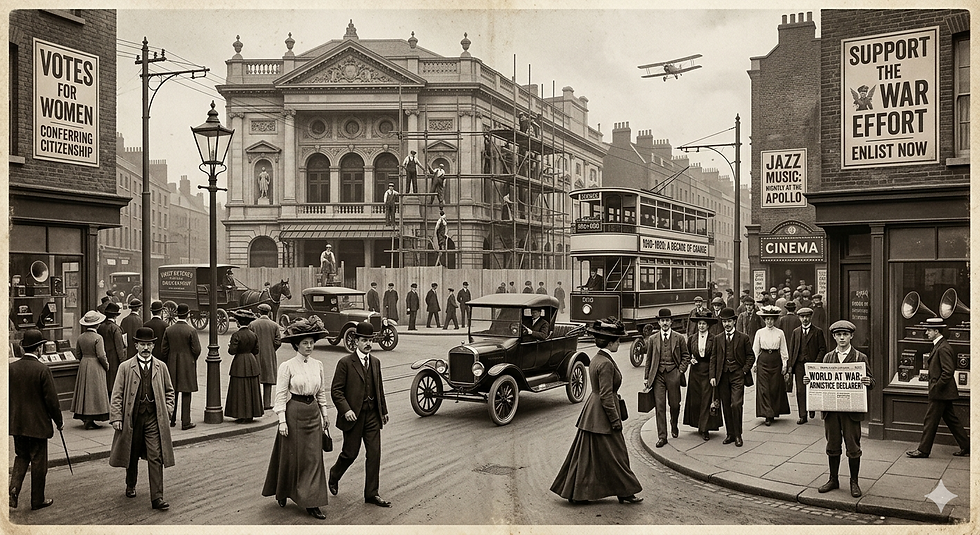
After analyzing the first decade, a decade certainly full of great inventions and progress but also of great shadows, the decade between 1910 and 1920 was one of the most tumultuous in modern history. It was a decade that was surely dominated almost entirely by the first global conflict and the collapse of secular empires. But let us truly go in order, because otherwise we risk getting lost.
1910–1920: Great discoveries and technological progress.
South Pole.
Let's start this paragraph with 1911 and the Conquest of the South Pole. This was a race to see who could get there first between the Norwegian explorer Roald Amundsen, who beats the British explorer Robert Falcon Scott to the punch, becoming the first to reach the southernmost point on the planet. Amundsen arrived on December 14, 1911, using sled dogs and an impeccable organization; Scott arrived only a month later, finding the Norwegian flag, and unfortunately lost his life on the return journey. This event marks the end of the "Heroic Age of Antarctic Exploration." Man had indeed touched the most extreme points of the continents, but vast areas of the Earth (like the interior of the Amazon, the ocean trenches and, shortly after, space) were still completely untouched.
Titanic.
Speaking of ice, 1912 was the year of "killer ice." Obviously, I am talking about the sinking of the Titanic. The Titanic was the largest and most luxurious ocean liner built up to that time. Humanity was so ecstatic about that steel beast that everyone thought an unsinkable ship had been built; the arrogance of the Belle Époque believed, in fact, that it had subdued nature with steel. That ship, considered indestructible and safe, was equipped with very few lifeboats and an insufficient number of sailors. To keep in mind. Tickets sold like hotcakes. At the departure from England, bound for the United States, people flocked in droves to wave goodbye to what was, in fact, already celebrated as a foregone success. Unfortunately, in that period the saying "never say never" did not yet exist.
During its maiden voyage, the "unsinkable ocean liner" struck an iceberg in the middle of the Atlantic Ocean that no one on board saw due to a lack of surveillance (the lookouts Frederick Fleet and Reginald Lee, on the bow, were not, in fact, equipped with binoculars). The ship took on water, and the lifeboats were unable to save everyone (being sufficient for about 1,178 people, compared to over 2,200 passengers who boarded). Those who saved themselves were largely those from first class, given that the third-class passengers remained trapped below deck, both due to the structural complexity of the corridors and because the gates separating the classes remained closed for hours. Then the ship broke in half and sank to the bottom, causing the death of many innocents.
That was the first true great civil tragedy at sea that could have been avoided if only icebergs had been kept under observation, if the ship had possessed sufficient lifeboats, and if there had been 24-hour watch shifts. That event led to the birth of the SOLAS (Safety of Life at Sea) convention in 1914, which finally imposed ironclad rules: sufficient lifeboats for all passengers, 24-hour radio watch shifts, and the establishment of the International Ice Patrol.
Bohr's Atom.
Then we have science. If with the South Pole and the Titanic, humanity measured its physical and technological limits in the face of the macroscopic. In 1913, the scientist Niels Bohr published his model of atomic structure, introducing the idea that electrons orbit the nucleus in defined energy levels.
That was the first brick for the entire study of chemistry, physics, biology, and energy. From that year onward, the scientific community studied the materials it knew from an atomic point of view, understanding how a great many physically observed phenomena actually occurred (I am thinking, for example, of heat transmission). Thanks to this discovery, it allowed, decades later, the development of technologies like lasers and semiconductors that we all use today in our smartphones and computers.
The Assembly Line.
While in Europe science was redefining the infinitely small and the deep universe, in the United States the backbone of modern industrial civilization was taking shape. In 1913, in Detroit, Henry Ford introduced the assembly line for the production of the Model T in his plants.
This was not simply a brilliant technical innovation but an unprecedented social and economic revolution. By fragmenting work into repetitive tasks and bringing the part directly to the worker via conveyor belts, Ford drastically slashed production times and, consequently, the final cost of the product. The automobile thus ceased to be a luxury toy for a few aristocrats and transformed into the first true mass consumer good. Small side note. To allow his own workers to purchase the car they themselves produced, Ford doubled the minimum wage to 5 dollars a day and reduced the workday to 8 hours. Thus was born the modern consumerist middle class. This formidable industrial acceleration did not only change the urban planning of cities and the lifestyle of American citizens, but it provided the United States with that gigantic and unstoppable productive apparatus that, a few years later, in 1917, would prove decisive in overturning and concluding the outcome of the First World War.
Einstein's Relativity.
And then we have the General Relativity of that extraordinary mind of Albert Einstein. The German physicist expanded his previous theory, explaining that gravity is not a force but the curvature of space-time caused by mass. This theory was the foundation of all modern astrophysical science. If today we know why the Earth rotates around the Sun at this speed and distance, it is precisely because of the application of Einstein's theory. Don't get me wrong: Newton had discovered gravity, applying it both to objects on our planet and to celestial bodies (universal gravitation). The true magic of Einstein's General Relativity, however, is that it explained the profound why: the Earth is not "pulled" by an invisible rope called gravity but is simply going straight in a space that the mass of the Sun has "curved" like a weight on a trampoline. Furthermore, Einstein made it possible to explain things that Newton could not predict, such as black holes, gravitational waves, and the deflection of starlight.
The Great War (1914–1918).
And here we are at the moment that has in fact marked an absurd and bloody page of our history. To talk deeply about this event would require a thousand-page book; in this paragraph, I would just like to mention some salient moments.
Even before the outbreak of the war in 1914, tension among European empires was very high. Away from the spotlight, a dense network of agreements and alliances was being created that had divided Europe practically in two: on one side, Germany, Austria-Hungary, and Italy (the Triple Alliance); and on the other, Russia, the United Kingdom, and France (the Triple Entente). In the previous century, events had already occurred that can now be considered dress rehearsals for the clash, in particular tensions in the Balkans and in Morocco.
The war in fact broke out because of a wrong turn. We are in 1914. Archduke Franz Ferdinand, heir to the throne of Austria, was on an official visit to Sarajevo. That morning he was supposed to go to the city hall, and he did so in a car (an open one, not like the armored ones of today) among the crowd. That same morning an attempt was made to assassinate the archduke with a bomb; the attempt was stopped; however, it was decided to change the route. The driver, who was not informed of the change, took the wrong road at an intersection, and during the maneuver, the car found itself in front of Gavrilo Princip, a young nationalist fighting for the independence of his people, who assassinated the archduke. That unprecedented event triggered the chain system of alliances that led to the outbreak of the First World War.
After a period of neutrality, Italy, in 1915, signed the Pact of London and entered the field against the Central Powers.
The First World War was a stationary war of attrition, fought at the front in the trenches, in the midst of mud, constantly breathing gunpowder, dirt, and toxic gases (like chlorine and mustard gas). This type of conflict led to only one consequence: the conquest of ridiculous territories at the cost of an inconceivable number of deaths. The battles of Verdun and the Somme, in 1916, marked the pinnacle of trench warfare, with millions of victims for minimal territorial gains. In 1917, the entry of the United States into the conflict alongside the Triplice Intesa shifted the balance of the war in an irreversible way.
On November 11, 1918, the armistice was signed, putting an end to the fighting. What was signed, however, was a "ceasefire," not a true peace agreement. A situation in some ways similar to what would occur decades later with the two Koreas, even if in that case a peace treaty was never signed. 1919, in fact, saw the signing of the Treaty of Versailles, which imposed harsh conditions on Germany, creating de facto the prerequisites for the birth of Nazism, the Holocaust, and the outbreak of the Second World War in 1939.
1910–1920: Revolutions and Collapses of Empires.
The First World War not only caused the useless death of millions of soldiers, but it also effectively sanctioned the end of many realities. Within four years, four of the most powerful empires on the planet collapsed definitively, erasing centuries of dynastic history: the German Empire, the Austro-Hungarian Empire, the Russian Empire, and the Ottoman Empire disappeared from geographic maps, giving way to a completely fragmented and unstable geopolitical map.
Not only was the First World War a moment of change, and not only was Europe crossed by epochal changes.
In 1910, the Mexican Revolution took place. Sure, it is not as important as the First World War, but it is a symptom of a world that was changing without pause. Mexico had been governed for thirty years by the dictatorship of Porfirio Díaz (the so-called Porfiriato), a regime that had enriched itself by selling the country's resources to foreign investors and crushing the peasants. In Mexico, a long civil war begins that will transform the social and political structure of the country. The revolution led by legendary figures like Pancho Villa in the north and Emiliano Zapata in the south demonstrated that the old model of colonial and latifundist exploitation was no longer tolerable. The Mexican Constitution of 1917, born from this war, was one of the most advanced in the world, introducing for the first time fundamental rights for workers and agrarian reform.
Between 1911 and 1912, the fall of the Chinese Empire occurred. The collapse of the Empire, which officially took place in February 1912 with the abdication of the last child emperor, Pu Yi, was not just a change of government. It was the end of the very concept of the "Mandate of Heaven" that had been going on for over two thousand years (since the Qin dynasty in 221 BC). Until then, the royal family was seen as a divine entity and, as such, untouchable, beyond the law.
The Xinhai Revolution, led by Sun Yat-sen, put an end to millennia of imperial rule and established the Republic of China. Sun Yat-sen tried to bring democracy and modernization to an immense country, although unfortunately the newborn Republic soon sank into the chaos of the "Warlords" and, subsequently, into civil war.
And then, returning to Europe, we have perhaps the most well-known revolution of all: the Russian one of 1917. Russia for some years had already been living in a very turbulent situation. In the previous decade, following the uprisings of 1905, the Tsar had tried to cool tempers by creating the "Duma," meaning the Russian parliament, and loosening the rope of control. Unfortunately, it was not enough. The tsarist regime collapsed in 1917, in the middle of the world war. In October, the Bolsheviks led by Lenin, inspired by the works of Karl Marx, took power. The royal family attempted an escape that did not succeed, subsequently leading to Russia's withdrawal from the war and the birth of the first socialist state in the world (the USSR will be formalized shortly after).
1910–1920: Society and Health.
1913 is a year painted in pink. The movement for women's right to vote intensifies protests. Many nations (like the United Kingdom in 1918 and the USA in 1920) will begin to grant female suffrage precisely in this decade. It is the signal that the feminist movement is being heard, and men are beginning to grant those rights that women, now workers, are rightly clamoring for.
How can we not mention the Spanish flu? We are in 1918. The First World War is over, and men return from the front with some of the most horrible physical and mental traumas, between mutilations and post-traumatic stress disorders. In addition to this, something incredible happened: someone, both in Kansas and on the French fronts, began to cough. Right then and there no one gave it weight, considering it an illness caused by the season. The tragic detail was that, due to war censorship, the countries involved in the conflict (France, England, Germany, and the USA) hid the news of the epidemic so as to not demoralize the soldiers and the population. Therefore, the soldiers returned home sick, infecting friends, work colleagues, and families: civilians who did not know why people in the cities were dying in droves. Then the cases multiplied like wildfire, and the seasonal illness became an epidemic. It seems almost like a déjà vu. The virus was discovered only during the pandemic from Spain. The Iberian nation remained neutral and did not have wartime censorship: its newspapers were the first to talk about it openly. The world, reading only Spanish newspapers, mistakenly convinced itself that the virus had started there.
Over the course of two years, that global pandemic hit a world already exhausted by the war, causing between 50 and 100 million deaths and far surpassing the victims of the military conflict itself.
In addition to a deadly virus, the end of the decade also brought with it another phenomenon: prohibitionism. In the United States, the 18th Amendment came into force, which banned the production and sale of alcohol. In itself it could seem like a good initiative, since it was a law that was supposed to keep people away from alcoholism and even serious health problems. What the government did not understand was a simple detail: if you forbid something to someone, that prohibition will be bypassed. And it was not just a matter of principle, but the fact that the alcohol market responded to a deep-rooted need and a colossal business.
That amendment kicked off the birth of clandestine bars (the speakeasies), where a wide consumption of alcohol obtained through illegal means by organized crime was recorded. The American mafia, also fueled by the European immigration of that period, on one hand entertained American society by managing nightclubs, but on the other hand was the main actor in bloody city feuds, like the famous St. Valentine's Day Massacre a few years later, in 1929.
1910–1920: Culture and Avant-gardes.
But let's completely change the subject and go talk about culture and art after paragraphs dense with death and devastation.
1910 was the year of the first abstract watercolor. The painter Wassily Kandinsky marked the birth of abstract art, moving away from the representation of reality, which, throughout the nineteenth century, had been the dominant theme and had monopolized art, giving painting that fairytale, almost dreamer-like aura. The painter destroys the geometric figure and objective reality precisely while science (with Bohr and Einstein) demonstrates that microscopic and macroscopic reality is not at all how we see it. Beautiful, this contrast of visions.
Three years later, in 1913, "The Rite of Spring" was staged. Stravinsky, with this work, brought obsessive, almost tribal and violent rhythms to the theater. At the debut in Paris, the public was so shocked by the dissonant harmonies that a real fight broke out in the hall. In hindsight, those harsh and almost violent sounds are a preview of the metallic and explosive soundtrack that would sweep Europe the following year.
Finally, in 1919, the Bauhaus was born. In Germany, Walter Gropius founded this famous school of art and design that would influence modern architecture throughout the century. The Bauhaus arose from the rubble of a country by then economically exhausted and on the verge of undergoing an unprecedented financial and hyperinflationary crisis. It was born with the idea of rebuilding a new world, uniting art with industry and eliminating the useless decorations of the past in favor of functionality.
Small reflections.
Ultimately, the decade between 1910 and 1920 was not simply a period of transition but a true particle accelerator of human history. If the Belle Époque had opened under the banner of technological arrogance and millenary certainties, it closed leaving behind a completely distorted and unrecognizable landscape. We have seen man touch the boundaries of the world at the South Pole and push himself to the secrets of the atom and space-time, while Ford's factories reinvented the very concept of work and society. Yet, that same extraordinary push toward the future showed its darkest and most lethal side: the unsinkable steel of the Titanic sank to the bottom, the assembly line armed the industry of death in the trenches, and the dreams of glory of millenary empires pulverized in the mud, leaving room for radical ideologies and unstable borders.
Even art, with the dissonances of Stravinsky and the decompositions of Kandinsky, had sensed the chaos even before the cannons began to fire or before the Spanish flu and Prohibitionism redesigned the concepts of health and legality. The Tens thus close, between the economic rubble from which the Bauhaus rises and the harsh chains of the Treaty of Versailles. Wounded humanity, but profoundly changed in its rights and social structure, thus looks out into the Twenties: an era that will be born under the sign of clandestine clubs and jazz, but which will bring with it, indelibly written in its genetic code, the wounds and lessons of the first, true global trauma of modernity.
M.

Comments